


















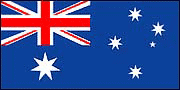
AUSTRALIA
Facts at a Glance
Full country name: Commonwealth of Australia
Area: 7,682,300 sq km
Population: 18,090,000 (growth rate 1.4%)
Capital city: Canberra (pop: 311,000)
People: 94% European descent, 4% Asian, 1.5% Aboriginal
Languages: English, Aboriginal languages (plus Italian, Greek and numerous other European and Asian languages)
Religion: 75% Christian, 1% Muslim, 1% Buddhist, 0.5% Jewish
Government: Independent member of the British Commonwealth
Prime Minister: John Howard
Governor-General: Sir William Deane
Sydney
Australia's premier city is the oldest settlement in Australia, the economic powerhouse of the nation and the country's capital in everything but name. Built on the shores of the stunning Port Jackson, you would have to die and go to heaven before you see a more spectacular setting for a city. It's a vital, self-regarding metropolis, exuding both a devil-may-care urbanity and a slavish obsession with global fads. Preparations for the 2000 Olympic Games are now underway as the city strives to bring its civic life on a par with its natural charms.
Melbourne
Australia's second city is a place of contradictions and hidden charms. A leafy, bayside community on the `upside-down', brown Yarra River, it is cosmopolitan, suburban, cultivated, football crazy, conservative and a haven for the avant-garde. Visitors come for its shopping, restaurants, nightlife and sporting calendar, encouraging many Melburnians to believe that they live in one of the most civilised cities in the world.
Environment
Australia is a vast island continent situated south of Indonesia and Papua New Guinea between the Pacific and Indian oceans. The world's sixth largest country, Australia measures some 4000km east to west and 3200km north to south. Much of the interior of the country is flat, barren and extremely sparsely populated. The bulk of the population lives on the narrow, fertile eastern coastal plain and on the south-eastern coast. The continent-long Great Dividing Range runs north-south down the eastern seaboard, separating the coastal plain from the drier inland areas. The Great Barrier Reef lies between 50-300km offshore and extends 2000km from the Torres Strait to Gladstone.
Australia is blessed with a fascinating mix of native flora and fauna. Its distinctive plants include the ubiquitous gum tree or eucalypt, of which there are some 700 species. Other common plants are wattle, banksia, waratahs, bottlebrushes, paperbarks and tea trees. Endemic animals include the iconic kangaroo, koala and emu, and the platypus, echidna, possum, wombat and dingo. There are also a number of interesting birds, such as parrots, cockatoos and kookaburras. Fauna to be wary of include Australian spiders (especially the redback and funnel-web), snakes (notably the venomous brown, tiger, death adder, copperhead and red-bellied black varieties) and both salt and freshwater crocodiles. There are more than 500 national parks, incorporating rainforests, deserts, mountain ranges and coastal dunes.
Australian seasons are the antithesis of those in Europe and North America: summer starts in December, autumn in March, winter in June and spring in September. Seasonal variations are not extreme and it's rare for temperatures to drop below zero on the mainland except in the mountains. As you head north, the seasonal variations become even less distinct. Darwin, in the far north, is in the monsoon belt, where there are just two seasons: hot and wet, and hot and dry.
The southern states are popular during the summer months, but the best time to visit is probably the shoulder seasons of spring or autumn when the weather in the south is mild, Queensland is still warm, the humidity is not too draining in the north and there are less flies in the bush. Spring in the outback can be spectacular if rains encourage wildflowers.