
















Cambodia
Most Cambodians consider themselves to be Khmers, descendants of the Angkor Empire that extended over much of Southeast Asia and reached its zenith between the 10th and 13th centuries. Attacks by the Thai and Cham (from present-day Vietnam) weakened the empire ushering in a long period of decline. The king placed the country under French protection in 1863. Cambodia became part of French Indochina in 1887. Following Japanese occupation in World War II, Cambodia gained full independence from France in 1953. In April 1975, after a five-year struggle, Communist Khmer Rouge forces captured Phnom Penh and evacuated all cities and towns. At least 1.5 million Cambodians died from execution, forced hardships, or starvation during the Khmer Rouge regime under POL POT. A December 1978 Vietnamese invasion drove the Khmer Rouge into the countryside, began a 10-year Vietnamese occupation, and touched off almost 13 years of civil war. The 1991 Paris Peace Accords mandated democratic elections and a ceasefire, which was not fully respected by the Khmer Rouge. UN-sponsored elections in 1993 helped restore some semblance of normalcy under a coalition government. Factional fighting in 1997 ended the first coalition government, but a second round of national elections in 1998 led to the formation of another coalition government and renewed political stability. The remaining elements of the Khmer Rouge surrended in early 1999. Some of the remaining leaders are awaiting trial by a UN-sponsored tribunal for crimes against humanity. Elections in July 2003 were relatively peaceful, but it took one year of negotiations between contending political parties before a coalition government was formed.
Geography
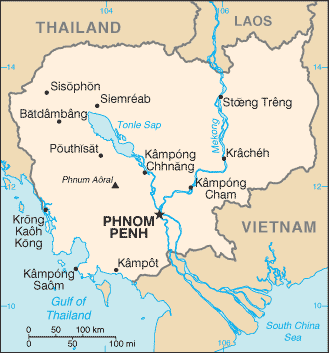
Southeastern Asia, bordering the Gulf of Thailand, between Thailand, Vietnam, and Laos
Government
Country name:conventional long form: Kingdom of Cambodia
conventional short form: Cambodia
local long form: Preahreacheanacha Kampuchea (phonetic pronunciation)
local short form: Kampuchea
former: Kingdom of Cambodia, Khmer Republic, Democratic Kampuchea, People's Republic of Kampuchea, State of Cambodia
Government
Government type: multiparty democracy under a constitutional monarchy established in September 1993
Capital: Phnom Penh
Administrative divisions: 20 provinces (khaitt, singular and plural) and 4 municipalities (krong, singular and plural)
: provinces: Banteay Mean Chey, Batdambang, Kampong Cham, Kampong Chhnang, Kampong Spoe, Kampong Thum, Kampot, Kandal, Koh Kong, Kracheh, Mondol Kiri, Otdar Mean Chey, Pouthisat, Preah Vihear, Prey Veng, Rotanakir, Siem Reab, Stoeng Treng, Svay Rieng, Takao
: municipalities: Keb, Pailin, Phnom Penh, Preah Seihanu
Economy
In 1999, the first full year of peace in 30 years, the government made progress on economic reforms. The United States and Cambodia signed a Bilateral Textile Agreement, which gave Cambodia a guaranteed quota of US textile imports and established a bonus for improving working conditions and enforcing Cambodian labor laws and international labor standards in the industry. From 2001 to 2004, the economy grew at an average rate of 6.4%, driven largely by an expansion in the garment sector and tourism. With the January 2005 expiration of a WTO Agreement on Textiles and Clothing, Cambodia-based textile producers were forced to compete directly with lower priced producing countries such as China and India. Economic growth slowed to an estimated 3.8% in 2005, due to sharply higher competitive pressures in the garment industry and early droughts in 14 of 24 provinces. Faced with the possibility that that its vibrant garment industry, with more than 200,000 jobs, could be in serious danger, the Cambodian government has committed itself to a policy of continued support for high labor standards in an attempt to maintain favor with buyers. The tourism industry continues to grow rapidly, with foreign visitors surpassing one million for the year by September 2005. The long-term development of the economy remains a daunting challenge. The Cambodian government continues to work with bilateral and multilateral donors, including the World Bank and IMF, to address the country's many pressing needs. In December 2004, official donors pledged $504 million in aid for 2005 on the condition that the Cambodian government implement steps to reduce corruption. The major economic challenge for Cambodia over the next decade will be fashioning an economic environment in which the private sector can create enough jobs to handle Cambodia's demographic imbalance. More than 50% of the population is 20 years or younger. The population lacks education and productive skills, particularly in the poverty-ridden countryside, which suffers from an almot total lack of basic infrastructure. Fully 75% of the population remains engaged in subsistence farming.