






















Italy

Facts at a Glance
Full country name: Italian Republic
Area: 301,250 sq km (117,487 sq mi)
Population: 57.6 million
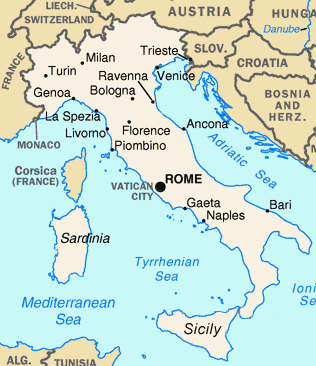
Capital city: Rome (pop 2.6 million)
People: Italian
Languages: standard Italian and numerous dialects, German, French, Slovene
Religions: 85% Roman Catholic, 5% Jewish and Protestant
Government: Republic
Prime Minister: Giuliano Amato
Rome
There's no escaping it: Rome means history. There's layers of the stuff - Etruscan tombs, Republican meeting rooms, Imperial temples, early-Christian churches, medieval bell towers, Renaissance palaces and Baroque basilicas. In this city a phenomenal concentration of history, legend and monuments coexist with an equally phenomenal concentration of people busily going about their everyday life. It's hard to say what you'll find most breathtaking about the eternal city - the arrogant opulence of the Vatican, the timelessness of the Forum, the top speed of a Fiat Bambino or the bill for your cafe latte.
Venice
There's no escaping it: Venice is unique. For a start, this is a pedestrian's city on a very human scale - cars are almost nonexistent, and beguiling narrow paths take the place of ugly city roads. The harmonious architecture seems to have sprung uniformly from somewhere between the 12th and 16th centuries, its secretive walls and enticing balconies sparkling with flashes of water glimpsed through cracks and windows. Dark paths suddenly emerge into the clear, bright daylight of a church-filled square or to cross the city's myriad canals by way of numerous and wonderful little bridges. The atmosphere is magical, and inexplicably festive.
The city is built on 117 small islands, and is linked to the mainland service town of Mestre by a road and rail causeway. The Grand Canal insinuates itself around the city, emerging at the unforgettable vista of Piazza San Marco, boasting its campanile, Doges' Palace, St Mark's Basilica and elegant pigeon-filled piazza. The Bridge of Sighs links the palace to the gloomy old prisons, and the bobbing gondolas are overlooked by the stunning Santa Maria della Salute, San Giorgio Maggiore and del Redentore churches. It takes only half an hour or so to walk from the train station to San Marco: that is if you can resist the temptation to take one of the many paths which diverge from the main drag (Lista di Spagna) and assuming that you can follow the signs which appear every now and then indicating nonsensical directions. To appreciate the fine palaces which line the Grand Canal, swallow your 'but I'm not really a tourist' phlegm and take a gondola.
The Accademia Bridge leads to a quieter Venice and the Galleria dell'Accademia, with its collection of Venetian masters. The nearby Peggy Guggenheim Gallery updates your walk through history and art, with its fine collection of early 20th-century works. Venice is surrounded by equally enchanting islands: the Lido (forever linked with Tommy Mann, Dirk and Death in Venice), Murano (the home of Venetian glass), Burano (famous for its lace) and strangely time-warped Torcello, with its Byzantine cathedral.