

















Turkey
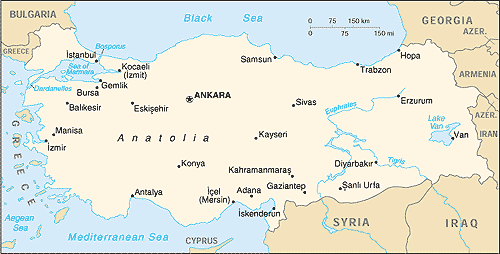
Turkey was created in 1923 from the Turkish remnants of the Ottoman Empire. Soon thereafter the country instituted secular laws to replace traditional religious fiats. In 1945 Turkey joined the UN and in 1952 it became a member of NATO. Turkey occupied the northern portion of Cyprus in 1974 to prevent a Greek takeover of the island; relations between the two countries remain strained. Periodic military offensives against Kurdish separatists have dislocated part of the population in southeast Turkey and have drawn international condemnation.
Geography
Location: southeastern Europe and southwestern Asia (that portion of Turkey west of the Bosporus is geographically part of Europe), bordering the Black Sea, between Bulgaria and Georgia, and bordering the Aegean Sea and the Mediterranean Sea, between Greece and Syria
Land boundaries: total: 2,627 km
border countries: Armenia 268 km, Azerbaijan 9 km, Bulgaria 240 km, Georgia 252 km, Greece 206 km, Iran 499 km, Iraq 331 km, Syria 822 km
Maritime claims: exclusive economic zone: in Black Sea only: to the maritime boundary agreed upon with the former USSR
territorial sea: 6 NM in the Aegean Sea; 12 NM in Black Sea and in Mediterranean Sea
Climate: temperate; hot, dry summers with mild, wet winters; harsher in interior
Terrain: mostly mountains; narrow coastal plain; high central plateau (Anatolia)
People
Population: 66,493,970 (July 2001 est.)
Ethnic groups: Turkish 80%, Kurdish 20%
Religions: Muslim 99.8% (mostly Sunni), other 0.2% (Christian and Jews)
Languages: Turkish (official), Kurdish, Arabic, Armenian, Greek
Government
Government type: republican parliamentary democracy
Independence: 29 October 1923 (successor state to the Ottoman Empire)
National holiday: Independence Day, 29 October (1923)
Constitution: 7 November 1982
Legal system: derived from various European continental legal systems; accepts compulsory ICJ jurisdiction, with reservations
Executive branch:
chief of state:President Ahmed Necdet SEZER (since 16 May 2000)
head of government: Prime Minister Bulent ECEVIT (since 11 January 1999)
cabinet: Council of Ministers appointed by the president on the nomination of the prime minister
note: there is also a National Security Council that serves as an advisory body to the president and the cabinet
elections: president elected by the National Assembly for a seven-year term; election last held 5 May 2000 (next scheduled to be held NA May 2007); prime minister and deputy prime minister appointed by the president
election results: Ahmed Necdet SEZER elected president on the third ballot; percent of National Assembly vote - 60%
note: president must have a two-thirds majority of the National Assembly on the first two ballots and a simple majority on the third ballot
Economy
Economy - overview: Turkey's dynamic economy is a complex mix of modern industry and commerce along with traditional agriculture that still accounts for nearly 40% of employment. It has a strong and rapidly growing private sector, yet the state still plays a major role in basic industry, banking, transport, and communication. The most important industry - and largest exporter - is textiles and clothing, which is almost entirely in private hands. In recent years the economic situation has been marked by erratic economic growth and serious imbalances. Real GNP growth has exceeded 6% in most years, but this strong expansion was interrupted by sharp declines in output in 1994 and 1999. Meanwhile the public sector fiscal deficit has regularly exceeded 10% of GDP - due in large part to the huge burden of interest payments, which now account for more than 40% of central government spending - while inflation has remained in the high double digit range. Perhaps because of these problems, foreign direct investment in Turkey remains low - less than $1 billion annually. Prospects for the future are improving, however, because the ECEVIT government since June 1999 has been implementing an IMF-backed reform program, including a tighter budget, social security reform, banking reorganization, and accelerated privatization. As a result, the fiscal situation is greatly improved and inflation has dropped below 40% - the lowest rate since 1987. The country experienced a financial crisis in late 2000, including sharp drops in the stock market and foreign exchange reserves, but is recovering rapidly, thanks to additional IMF support and the government's commitment to a specific timetable of economic reforms.